

PR, Advertising, and the Fine Line Between Editorial and Promotion
Working in PR for almost three decades, I have learned that reach is not everything — quality of audience matters more. This is why Financial Times has always fascinated me. Its readership is not counted in hundreds of millions, but in hundreds of thousands of highly engaged, influential decision-makers. For a communicator, that is priceless.
But what really sets Financial Times apart is not only its audience but its editorial plan. It is thoughtful, balanced, and almost always offers the right background for your message to land in the right context.
This post, however, is not about my professional relations with FT, but rather a private observation.
A lesson from Cyprus
Many years ago, I worked with a client in Cyprus — Michael Leptos Group, then one of the island’s largest developers. I remember a double-spread article in FT about the Cypriot property market and my client’s role in shaping it.
But at the bottom corner of that spread, there was a small advertisement from Aristo Developers, a much smaller competitor at the time. It was a simple ad: a telephone number, a website, and a direct invitation to contact them.
The lesson was striking:
- Editorial coverage builds credibility and context.
- Advertising gives you a direct voice and call to action. Together, they form a powerful synergy.
Déjà vu in Almaty
Last week, I experienced a similar moment while reading FT Weekend Magazine. It was a three-page feature by Eric Kendall with photographs by Penny Kendall, beautifully capturing the potential of Almaty as a ski destination.
At the end of the article, just like in Cyprus years ago, there was a small note — this time about Andrey Golovachev, a local guide. It mentioned his company, his website, and the packages he offers (eight-night trips, including cat-skiing and ski-touring, starting from €2,280).
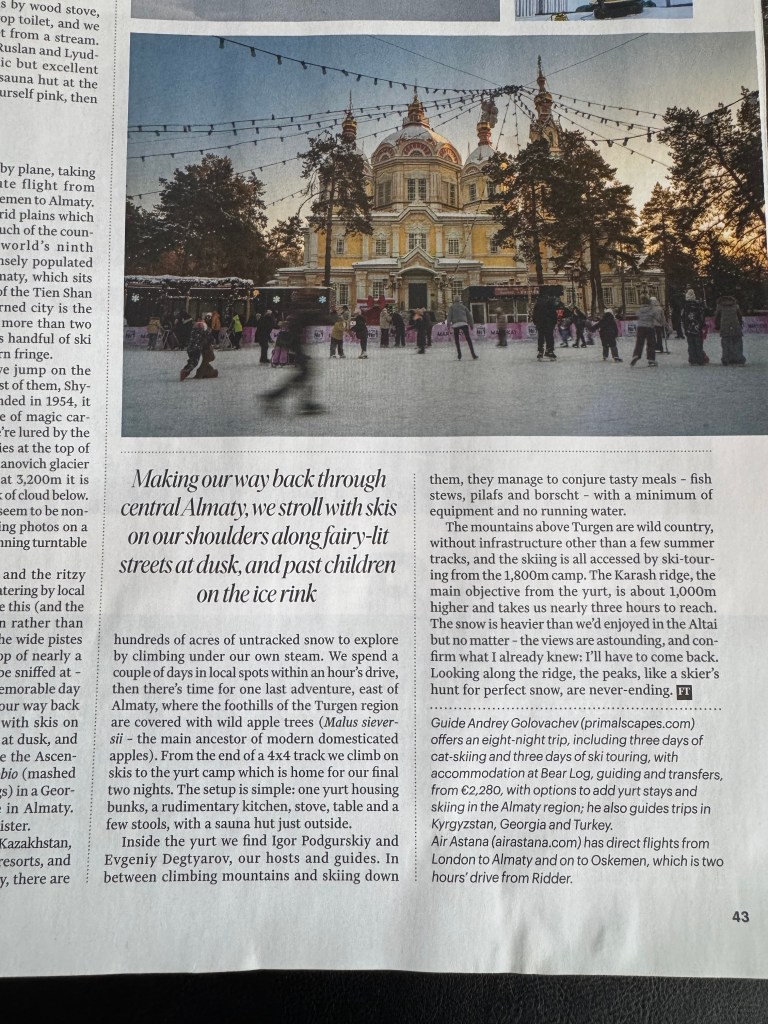
Was it advertising? Not exactly. It was part of the story, a journalist’s acknowledgment of a partner who made the trip possible. Yet from the reader’s perspective, the effect is almost identical to advertising.
The fine line
Editorial teams will always emphasise their independence. And I do believe in the integrity of good journalism. But in practice, stories are built on relationships — business, personal, and professional. Those relationships inevitably show through in the content.
As readers, we are often left to decide where information ends and subtle promotion begins. And that’s not necessarily a bad thing. In fact, when done well, it strengthens the narrative.
My takeaway
What matters is not whether something is labelled as PR, advertising, or pure editorial. What matters is the synergy between credibility and visibility:
- A strong editorial piece provides the context and authority.
- A small, clear message at the right moment provides the invitation to act.
That synergy is timeless. I saw it in Cyprus. I saw it in Almaty. And I’m sure I’ll see it again in many other contexts.
Share your examples
I’d love to hear from you. Have you seen similar cases where editorial and subtle promotion blended in a way that made you pause? It could be in newspapers, magazines, television, or digital media.
👉 Please fill in the short form and share your examples.
On my side, I promise to take these cases further: I will analyse and discuss them during my lectures, seminars, and creative labs. They will become part of my training courses on modern media, international branding, and strategic communications, where we look at how journalism, PR, and advertising overlap — and what that means for brands, institutions, and audiences.
Together, we can build a collection of real-life case studies that highlight the fine line between credibility, creativity, and commercial impact.


 Sergey Stanovkin