
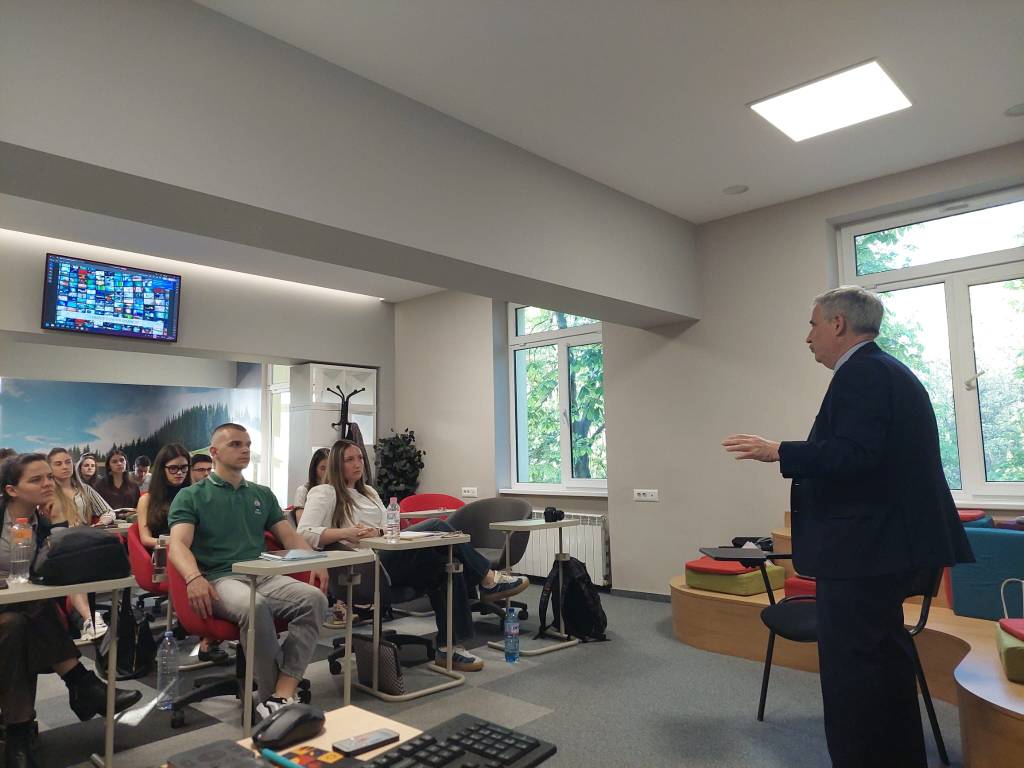
On 28 April 2026, I had the pleasure of returning to Sofia University St. Kliment Ohridski, where I delivered a lecture at the Faculty of Economics and Business Administration as part of the two-day conference “Law for Young Entrepreneurs: How to Build a Business Without Legal Risks.”
It was particularly meaningful for me to be back at the university for the second time. During my previous visit, we discussed investment branding at the national level — how countries position themselves to attract international capital. This time, the focus shifted to a different, but closely related topic: corporate branding and its role in building successful businesses.
What made this session especially engaging was the audience. The room was filled not only with students, but also with alumni, young entrepreneurs, and founders who are already building their own companies. That changed the dynamic completely — the discussion was not theoretical, but practical, grounded in real challenges and ambitions.
I always find it particularly rewarding to speak with people at this stage of their journey. There is a certain clarity and openness in how young entrepreneurs approach business: they are building from scratch, making decisions in real time, and thinking very directly about risk, growth, and positioning.
This made it natural for us to move beyond general concepts and into concrete examples. We discussed cases of well-known startups such as Revolut and Bolt, looking at how they built their brands not simply through marketing, but through clear positioning, consistency, and strategic communication.
One of the key ideas I wanted to convey is that corporate branding is often misunderstood, especially at the early stages of a business. It is frequently seen as something secondary — something to think about after the product is built, after the legal structure is in place, after the company becomes visible.
In reality, the opposite is true.
From the very beginning, a company is being perceived — by partners, by investors, by clients, and even by competitors. The question is not whether a brand exists, but whether it is being shaped deliberately or left to chance.
In the context of a conference focused on legal risk, this perspective becomes even more important. Legal compliance creates the framework in which a business operates, but it does not, on its own, create trust. Trust is built through clarity, consistency, and credibility — and this is exactly where corporate branding plays a decisive role.
We also spoke about the challenges of operating in today’s information environment. Companies do not control the news cycle. They do not fully control how they are perceived. In many cases, perception is shaped by fragmented signals, by isolated events, or even by misinformation.
This is why reactive communication is no longer sufficient. Entrepreneurs need to think proactively about how their company is understood — not only in moments of visibility, but continuously.
Another aspect that generated strong discussion was the role of accessibility of information. It is not enough to exist as a company; you must be understandable. Different stakeholders — investors, regulators, partners — interpret information differently, and communication needs to be structured accordingly.
What I particularly appreciated about this session was the level of engagement. The questions were thoughtful, direct, and often very practical. It was clear that the participants were not just interested in theory, but in how these ideas can be applied in their own businesses.
For me, this is always the most valuable part of such events — the dialogue. It is one thing to present a framework, but something entirely different to test it in conversation with people who are actively building companies.
I would like to thank the Faculty of Economics and Business Administration and Sofia University St. Kliment Ohridski for the invitation and for the opportunity to engage with such a motivated and forward-looking audience.
If these ideas resonate with you, whether you are building a company, shaping a brand, or considering how your organisation is perceived, I would be very interested in continuing the conversation. You are welcome to share your thoughts or outline your project through the contact form below. This will help us start a more focused and meaningful discussion.


