
Why Communication Will Define the Future of Estonia’s Digital Economy
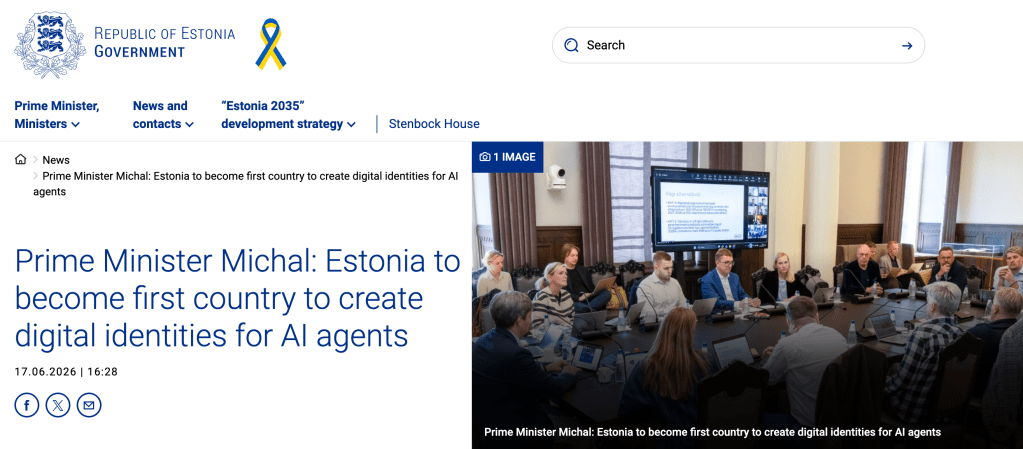
When the Government of Estonia announced in June that it intends to become the first country in the world to introduce official digital identities for AI agents, many observers understandably focused on the technology itself. The announcement was presented as another milestone in Estonia’s remarkable digital journey and quickly attracted international attention. Once again, the small Baltic nation demonstrated that it was prepared not merely to adopt emerging technologies but to help shape the rules governing their future use. It was a bold decision, entirely consistent with Estonia’s reputation as one of the world’s most innovative digital societies.
Yet for me, the announcement raised a different question. Not whether Estonia could achieve this objective. History suggests that it probably can. The more interesting question is whether the world is fully aware of what Estonia has already become.
This may sound surprising. After all, Estonia has been one of the most frequently cited examples of successful digital transformation for more than twenty years. Governments from every continent have visited Tallinn to study its experience. International organisations regularly refer to Estonia as a benchmark for digital government. Universities teach the Estonian model as a case study. Technology conferences routinely invite Estonian officials to explain how a nation of barely 1.3 million people succeeded in creating one of the world’s most sophisticated digital societies.
And yet, despite all these achievements, I increasingly believe that Estonia’s greatest challenge over the next decade will not be technological.
It will be communications.
This is not a criticism. Quite the opposite. It is, in many respects, a consequence of extraordinary success.
For almost a generation Estonia has been associated with one remarkable achievement: digital government. The country’s digital identity system, electronic signatures, online public services, digital taxation, e-Residency and X-Road interoperability platform have collectively become one of the strongest national brands in modern Europe. Few countries have managed to create such a clear and positive international association.
The problem is that international perception often freezes at the moment when success first becomes widely recognised. The world still speaks about Estonia as if its greatest innovation is digital government. Estonia itself has already moved much further.
Today, the country’s ambitions extend well beyond public administration. Artificial intelligence, deep technology, cybersecurity, research commercialisation, advanced manufacturing, defence technologies, clean technologies and globally scalable innovation companies increasingly dominate the national agenda. Estonia is no longer trying simply to build the world’s smartest digital government. It is trying to build one of Europe’s most competitive digital economies.
Those are two very different ambitions. Digital government transforms the relationship between citizens and the state. A digital economy transforms the relationship between innovation and prosperity.
It attracts investment.
It commercialises research.
It creates globally competitive companies.
It exports knowledge rather than commodities.
It attracts entrepreneurs, engineers and investors from around the world.
Most importantly, it creates sustainable economic growth.
This distinction matters because many countries are now entering precisely the same phase of development. During the past decade governments have invested heavily in digital public services. The next stage is significantly more competitive. Nations are no longer competing simply to digitise government. They are competing to become centres of artificial intelligence, scientific research, entrepreneurship and technological innovation. They are competing to attract capital, talent and globally mobile companies. The competition has become economic rather than administrative.
Estonia enters this competition with remarkable advantages.
Few countries possess such a combination of trusted institutions, advanced digital infrastructure, entrepreneurial culture, highly educated workforce, internationally respected public administration and regulatory stability. These assets cannot be created overnight. They are the product of decades of consistent policy, political courage and public confidence.
Indeed, if I had to identify Estonia’s single greatest competitive advantage, I would not choose digital identity or artificial intelligence.
I would choose trust.
Technology itself is never enough. Software can be purchased. Platforms can be copied. Artificial intelligence will eventually become available everywhere.
Trust cannot.
Estonia’s digital ecosystem functions because citizens believe in it. They trust their institutions to protect their personal data. They trust digital signatures. They trust online voting. They trust electronic medical records. They trust the legal framework that supports the technology.
This trust is perhaps Estonia’s most valuable strategic asset and one that is frequently underestimated outside the country. Ironically, however, it is also one of the reasons why Estonia now faces a completely different communications challenge.
Success has created expectations.
When international investors hear the word “Estonia”, they immediately think of digital government. That association is enormously valuable, but it is also becoming incomplete. It reflects what Estonia achieved yesterday rather than what Estonia is trying to achieve tomorrow.
The country has, in effect, become a victim of its own success.
Its strongest international brand is so powerful that it sometimes overshadows the next chapter of its development.
This is not unusual.
Many countries spend decades trying to build a single clear international identity. Estonia succeeded. The challenge now is evolving that identity without losing the strengths that made it successful in the first place.
In many respects, this is no longer a technological question. It is a branding question. And ultimately, it is a question of communication.
Interestingly, Estonia’s own nation-branding specialists have reached a remarkably similar conclusion.
In an interview published by The Place Brand Observer, Kata Varblane, Director of Country Promotion at Enterprise Estonia, explained that one of the country’s principal challenges is not reputation but awareness. Estonia, she observed, enjoys a very positive image among those who know it well, yet it is still not sufficiently well known in many international markets. She also pointed out that perceptions differ from country to country, meaning that international communication cannot rely on a single universal message but must be adapted to different audiences. That observation deserves much greater attention because it fundamentally changes how we should think about Estonia’s future international positioning.
Source:
https://placebrandobserver.com/kata-varblane-interview/
This distinction between awareness and reputation is one of the most important concepts in strategic communications, and it is often misunderstood.
Reputation answers the question: “What do people think about us?”
Awareness answers a different question: “How many relevant people think about us at all?”
Estonia has largely solved the first challenge.
The second remains very much a work in progress.
For investors, entrepreneurs and multinational companies, a country cannot become a serious consideration if it never enters the shortlist in the first place. Awareness therefore precedes investment. It precedes tourism. It precedes exports. It even precedes diplomacy. Countries do not compete only through policy. They compete for attention.
And attention has become one of the world’s scarcest resources. Attention, however, is only the beginning.
The real objective is relevance.
This is where I believe Estonia is approaching one of the most interesting moments in its modern history.
For many years, the country’s international communication has understandably focused on explaining how Estonia reinvented government. It was an extraordinary story and deserved the attention it received. The world was fascinated by the idea that a country could operate almost entirely online, that taxes could be filed in minutes, that entrepreneurs could establish companies remotely, that digital identities could be trusted and that bureaucracy could become almost invisible.
These achievements fundamentally changed international perceptions of what government could be.
But governments do not create prosperity on their own.
Businesses do.
Innovation does.
Research does.
Entrepreneurs do.
The challenge for Estonia over the coming decade will therefore be different from the one it successfully addressed twenty years ago. The objective is no longer convincing the world that Estonia has an efficient digital government. The objective is demonstrating that Estonia has become one of Europe’s most exciting places to build globally competitive businesses.
That transition may appear natural, but it requires a very different communications strategy.
Government services are relatively easy to explain because they are tangible and measurable. Innovation ecosystems are far more complex. They depend on thousands of interconnected decisions, relationships, institutions and individuals working together. The story becomes richer, but it also becomes more difficult to communicate.
Recent developments clearly demonstrate that Estonia understands this challenge. The government’s decision to establish legal digital identities for AI agents is not simply another technology project. It is a statement of ambition. It tells investors, entrepreneurs and researchers that Estonia intends to remain at the forefront of the next technological revolution rather than relying solely on achievements from the previous one.
The same ambition can be seen in Estonia’s growing emphasis on deep technology. Through new investment programmes, the government is encouraging universities, research institutions, science parks and private investors to work together to transform scientific discoveries into internationally competitive companies. The objective is no longer merely producing excellent research. It is creating economic value from that research through commercialisation, international partnerships and investment.
This represents one of the defining economic challenges of our time. Scientific excellence no longer guarantees economic success. Countries increasingly compete according to how effectively they convert knowledge into globally scalable businesses. Universities create discoveries. Companies create markets. Communication connects the two.
In this respect, Estonia already possesses considerable strengths. Its education system consistently ranks among Europe’s strongest. Its entrepreneurial culture has produced internationally recognised companies despite the country’s relatively small population. Its digital infrastructure enables businesses to operate with remarkable efficiency. Public institutions generally understand technology better than in many larger economies, allowing innovation to move from concept to implementation far more rapidly.
These advantages should not be underestimated. Nor should they be taken for granted. Every competitive advantage eventually becomes a competitive necessity.
Twenty years ago, digital government distinguished Estonia from almost every other country. Today, almost every developed nation is pursuing digital transformation. Tomorrow, artificial intelligence will become equally widespread. The question will therefore no longer be who adopted technology first. The question will be who created the most innovative economy around that technology.
This brings us to another challenge that receives less international attention than it deserves: economic growth.
Over the past several years Estonia, like much of Europe, has experienced a period of slower economic performance. Inflation, higher energy prices, geopolitical uncertainty following Russia’s invasion of Ukraine and weaker demand from several export markets have all affected growth. International organisations such as the OECD have noted that although recovery has begun, maintaining productivity growth, expanding exports and increasing investment remain central priorities for the coming years.
Source: OECD Economic Survey Estonia 2026
https://www.oecd.org/content/dam/oecd/en/publications/reports/2026/06/oecd-economic-surveys-estonia-2026_0c766603/2514521c-en.pdf
This is precisely why communication matters. Economic development is often discussed as though it depended exclusively on taxation, regulation, education or infrastructure. Those factors remain essential. But they are no longer sufficient.
Global investment increasingly follows visibility.
Talented entrepreneurs relocate to places they understand.
Scientists collaborate with institutions they recognise.
International corporations establish partnerships where confidence already exists.
Communication therefore becomes part of economic infrastructure.
One cannot attract what one fails to explain.
One cannot build international confidence through silence.
One cannot expect global audiences to appreciate achievements that have never been properly presented to them.
This observation became particularly clear to me while working on international strategic communications projects across Central Asia.
Today I am involved in an international communications campaign supporting Uzbekistan’s rapidly developing digital economy through BBC platforms. At first glance, comparing Uzbekistan and Estonia might appear unusual. The two countries are clearly at different stages of digital transformation, with very different histories, institutional capacities and economic structures.
Yet despite these differences, I have noticed something remarkably similar. Both countries increasingly recognise that their future competitiveness depends not only on what they build but also on how effectively they communicate it.
Uzbekistan is working hard to present itself as an emerging digital economy rather than simply a country undertaking administrative reforms.
Estonia faces the opposite challenge. It must persuade the world that it has already moved beyond digital government into a much broader innovation economy.
Different starting points. The same communications challenge.
There is another issue that deserves much greater attention because it lies at the intersection of strategic communications and economic development: corporate branding.
During more than three decades working in international media, strategic communications and nation branding, I have repeatedly encountered organisations that invested enormous resources in promoting individual products while paying relatively little attention to building the corporate identity behind them.
The consequences are often invisible in the short term. Successful products sell. Markets grow. Revenue increases.
Yet something valuable is quietly lost.
Long-term corporate reputation. That distinction becomes particularly important when discussing countries rather than individual businesses. A nation brand is never created by the government alone. It is built collectively.
Every successful company contributes to the international perception of its country. Every entrepreneur becomes an ambassador. Every internationally recognised innovation strengthens national credibility. Every corporate success becomes part of the country’s story. This relationship between country branding and corporate branding is frequently underestimated. In my opinion, Estonia represents one of the most interesting examples of this phenomenon.
Around the world, millions of people use products and services created by Estonian companies without necessarily realising where those companies come from. Skype changed the way the world communicates. Wise transformed international money transfers. Bolt redefined urban mobility in dozens of countries. Veriff has become one of Europe’s leading digital identity verification companies. Pipedrive, Starship Technologies and a growing number of other Estonian businesses have established impressive international reputations in highly competitive markets.
These companies are remarkable commercial success stories. At the same time, they reveal something that I believe deserves much greater discussion. In many cases, international audiences know the products far better than they know the companies behind them. Even when they recognise the companies, they do not always associate them strongly with Estonia itself. This is not unique to Estonia, but because the country has invested so successfully in building its national reputation, the issue becomes particularly interesting.
In my view, there is an opportunity to create a much stronger connection between three different levels of branding: the nation brand, the corporate brand and the product brand. Traditionally, most organisations concentrate their marketing efforts on products and services. It is understandable. Products generate immediate sales, product campaigns are easier to measure, and marketing budgets are usually linked to commercial performance rather than long-term corporate reputation.
Yet the world’s strongest companies rarely build their success on products alone. Apple is not simply a collection of devices; it represents a philosophy of innovation and design. Microsoft is far more than software; it stands for a particular vision of how technology empowers people and organisations. NVIDIA is no longer recognised only as a manufacturer of computer chips; it has become synonymous with the future of artificial intelligence. Investors, partners and customers increasingly buy into companies because they understand the organisations behind the products. They recognise the leadership, the culture, the long-term vision and the values that shape those products.
Exactly the same principle applies to countries. Corporate branding has become one of the most powerful instruments of economic diplomacy. When international investors evaluate companies, they rarely analyse products in isolation. They examine leadership, governance, innovation culture, research capability and strategic ambition. These qualities belong to corporate branding rather than product marketing. Strong corporate brands create confidence, confidence attracts investment, investment creates growth, and growth reinforces the country’s international reputation. This creates a virtuous circle in which successful companies strengthen the national brand, while a respected national brand makes it easier for new companies to succeed internationally.
Estonia has already mastered one half of this equation. It has built one of Europe’s strongest national technology brands. The next opportunity is to ensure that a larger number of Estonian companies consciously become international ambassadors for that national brand. This does not mean replacing product marketing. On the contrary, it means complementing it. The most successful international companies understand that every product launch is also an opportunity to strengthen corporate reputation. Every conference appearance promotes not only a service but also the organisation’s values. Every interview becomes an opportunity to explain where the company comes from, how it innovates and why its corporate culture matters. Over time, these stories accumulate. They create familiarity, build trust and ultimately attract investment.
For this reason, I believe corporate branding deserves to become a much more important part of Estonia’s broader economic strategy. For years, Estonia has invested successfully in communicating the excellence of its public institutions. The next stage should involve communicating the excellence of its companies with the same consistency and strategic ambition. The relationship between government communication and corporate communication should become mutually reinforcing. Every successful Estonian technology company should strengthen Brand Estonia, while every improvement in Estonia’s international reputation should create new opportunities for Estonian companies. These are not parallel processes; they are parts of the same ecosystem.
There is another reason why this matters. International competition has fundamentally changed over the past decade. Countries once competed primarily for manufacturing investment. Today they compete for something far more valuable: ideas, entrepreneurs, researchers, venture capital, artificial intelligence specialists and companies that may employ only a few hundred people while creating billions of euros in value. Tax policy, education, infrastructure and regulation remain essential, but they are no longer sufficient. Increasingly, perception matters just as much as policy.
Every country wants to be recognised as innovative. Every government wishes to attract technology investment. Every innovation agency speaks about artificial intelligence, startups and research. As a result, genuine differentiation has become much harder. This is where Estonia possesses an extraordinary advantage. Unlike many countries, Estonia does not need to invent an innovation story – it already has one. Its challenge is different. It must ensure that the story continues to evolve and that international audiences understand Estonia is not standing still.
Too often, countries become prisoners of their own success. The world remembers the achievements that first made them famous while overlooking everything that happened afterwards. That is precisely the risk Estonia now faces. The international narrative still revolves around e-government, digital identity and e-Residency. These remain exceptional achievements, but they are increasingly becoming the foundation rather than the destination. The next chapter is artificial intelligence. The next chapter is research commercialisation. The next chapter is deep technology. The next chapter is building globally recognised innovation companies. The next chapter is creating an ecosystem in which entrepreneurs, researchers, investors and highly skilled professionals choose Estonia not simply because government services are efficient but because it has become one of Europe’s most attractive places to create the technologies of the future.
In many respects, Estonia has already begun writing that chapter. The challenge now is ensuring that the rest of the world reads it.
If you’ve actually made it all the way through the article, congratulations—and thank you! I’d genuinely love to hear your thoughts, so please leave a comment.
If, on the other hand, you scrolled straight to the bottom (I promise I won’t take it personally), you’re equally welcome to leave a comment. Just ask me, “So… what was it about, and what possessed you to write something this long?” I’ll be delighted to explain!


