
Why my experience of Russia makes me see American politics, technology billionaires and international journalism differently.
In recent days, American and international media have been busy calculating how much money Elon Musk lost in the US midterm elections on 3 November 2026.
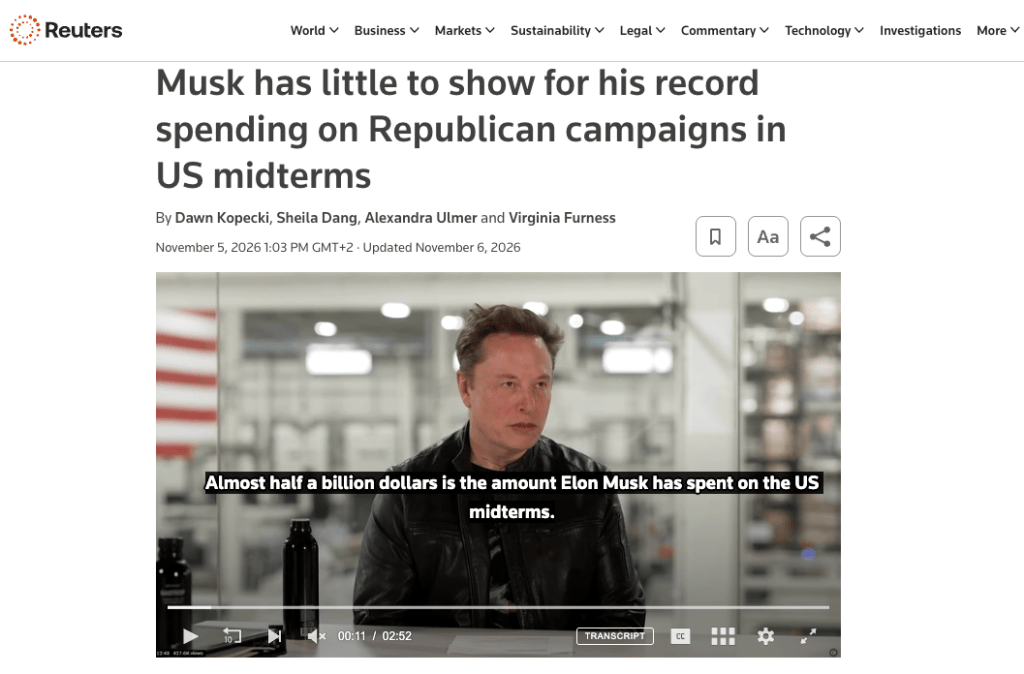
Reuters reported on 5 November that Musk had spent almost half a billion dollars supporting Republicans, yet most of the candidates he backed were defeated.
On 4 November, Forbes published an article with the revealing headline “Elon’s ROI: $458 Million Didn’t Buy Much In The Midterms”. Its journalists calculated that Musk had supported candidates in 106 Senate and House races. At the time of publication, just 19 had won, 47 had lost, and the remaining results had yet to be finalised.
The Financial Times went further on 5 November, publishing an article about the more than $600 million spent by technology billionaires supporting Republicans. Its headline, “The money didn’t work”, effectively delivered the verdict: the money had failed.
But is that really the case? I have no intention of defending Elon Musk or suggesting that he achieved the political results he wanted. I am interested in a rather different question.
Why have journalists decided that these expenditures should be treated as investments whose returns are measured by election results?
Why do we automatically assume that entrepreneurs who have built some of the world’s largest companies are spending hundreds of millions of dollars on politics solely to secure victories for particular candidates?
What if they are paying for something else entirely?
A Perspective from the Russia I Left 36 Years Ago
I left Russia in 1990. Since then, I have lived predominantly in the United Kingdom, but throughout these years I have continued to follow political and economic developments in Russia closely. That experience may explain why I interpret certain developments in contemporary America differently from the way they are commonly presented in the Western press.
In the early 2000s, Russia was still undergoing economic reforms that had begun under Boris Yeltsin. Private enterprise was developing, the rules governing business were changing, and new relationships were emerging between entrepreneurs and state institutions. Some major businesspeople sought closer relationships with political power. They financed political parties, supported government initiatives and participated in social and public projects.
This was not always an expression of political conviction. For many, it was a pragmatic way of building relationships with people whose decisions could influence the conditions in which their businesses operated. But another point is equally important: at that time, a great many successful companies stayed out of politics altogether. They operated, expanded, paid taxes and saw no reason to finance political parties or government initiatives.
Political involvement remained a choice, rather than a universal condition of doing business.
Gradually, however, the situation changed. The shift became particularly noticeable after 2011, when various forms of participation in government and social programmes assumed growing importance in the relationship between large businesses and the state.
The concept of “socially responsible business” became increasingly prominent. There is, of course, nothing inherently wrong with it. Companies are perfectly entitled to support education, healthcare, culture, sport, urban development and many other worthwhile causes.
But there is a fundamental difference between voluntary corporate social responsibility and a situation in which participation in such programmes becomes an unspoken expectation of those in power. At a certain point, businesses begin to regard these expenditures not as philanthropy, not as investment and not even as a means of gaining political advantage. They become part of the ordinary cost of doing business.
It is precisely this transition that I consider particularly relevant to understanding what may be happening in the United States today.
Investment or the Cost of Doing Business?
Let us return to Elon Musk. As early as 23 October, Bloomberg reported that Musk’s spending in support of Republicans during the election cycle had exceeded $445 million.
But Musk is far from the only representative of American technology business directing substantial funds towards political purposes.
In May, Bloomberg published an extensive investigation entitled “The Billionaires Behind the Most Expensive Midterm Elections in History”.
It featured not only Musk, but also Jeff Yass, Marc Andreessen, Ben Horowitz, Greg and Anna Brockman, Paul Singer, Miriam Adelson and other major American political donors. Of course, they do not all support the same party, nor do they all belong to the technology sector.
Forbes separately examined the political spending of billionaires associated with the artificial intelligence industry, including Greg Brockman, Dario Amodei, Marc Andreessen and Ben Horowitz. Some supported candidates from both parties, and their electoral outcomes varied considerably.
Yet behind all these figures lies a question that, in my view, receives insufficient attention. What exactly are billionaires buying when they finance political activity?
The victory of a particular candidate? Favourable legislation? Access to the administration? The opportunity to be heard when decisions are made about the regulation of artificial intelligence, energy, the space industry or cryptocurrencies?
Or simply the confidence that their companies will be able to continue operating within the existing political environment? These are different objectives. Their effectiveness cannot be measured in the same way.
Naturally, genuine ideological motivations also exist. Some entrepreneurs sincerely share Republican political views. Others finance both parties, seeking to ensure that their interests are represented regardless of the electoral outcome.
I do not know what motivates each individual donor. But my experience of Russia leads me to consider another hypothesis: political spending by major businesses may gradually evolve from voluntary investment in political influence into a form of payment for the ability to conduct business normally under the government of the day.
If that is the case, the defeat of candidates supported by those businesses tells us very little about the effectiveness of their expenditure. After all, we do not describe a company’s spending on office rent, legal services or regulatory compliance as failed investments simply because they generate no independent profit.
We recognise them as costs necessary to sustain operations. Perhaps at least some political expenditure should be analysed in much the same way.
Why Does the Government Need Private Money?
Another example strikes me as particularly revealing: the construction of a new ballroom at the White House.
Donald Trump’s administration has repeatedly emphasised that the project is being financed through private donations rather than American taxpayers’ money. At first glance, this sounds entirely positive. The public budget saves money, while wealthy entrepreneurs voluntarily finance a public project.
But I would ask a different question. Why should a government facility associated with the official residence of the President of the United States depend on private financing in the first place?
And why should we regard such financing as an unquestionable benefit without examining the relationship between the donors and the government?
Major donors reportedly included Apple, Nvidia, individuals associated with Palantir and Microsoft, and other companies and individuals from the financial and technology sectors.
The journalists noted that some donors also had significant interests in government regulation, public contracts and administrative decisions. None of this, by itself, proves any violation of the law. Nor does it establish that the donations were compulsory or made in exchange for specific decisions.
But does the absence of a proven legal violation eliminate every other legitimate question? In Russia, I observed how the state, while collecting taxes, increasingly involved businesses in financing activities traditionally regarded as government responsibilities.
This created a peculiar situation. On the one hand, businesses paid taxes intended to finance public functions. On the other, they were expected to contribute additional funds to various initiatives favoured by the authorities.
Moreover, the effectiveness and transparency of these additional expenditures did not always match the standards expected of public budgets. I am not suggesting that exactly the same thing is happening in the United States.
But the very logic by which private financing of government initiatives is presented as a special achievement of an administration deserves much closer examination. The essential question is not how much money the government has saved.
The question is what kind of relationship develops between those in power and those who provide them with additional funding.
Morality and the Law Are Not the Same Thing
This brings me to another issue that I believe is gradually disappearing from contemporary political debate: the distinction between legality and moral acceptability.
After decades of living in Britain, I have become accustomed to the principle that political accountability does not necessarily begin with a court judgment. In British and some other European political traditions, a minister or senior public official may face calls to resign not only because of a proven breach of the law, but also because their conduct is considered incompatible with the ethical standards expected of public office.
Of course, this principle is not always applied consistently. European politics offers numerous examples of politicians remaining in office despite serious ethical criticism. Nevertheless, the underlying distinction matters: political accountability extends beyond criminal and civil liability.
In Russia, I observed a gradual change in public debate. Questions about whether the conduct of those in power was acceptable were increasingly met with a familiar response: prove that the law has been broken; take the matter to court.
But morality is not defined exclusively by judicial decisions. Morality encompasses society’s understanding of acceptable and unacceptable behaviour, which is not always — and cannot always be — fully codified in law.
It is possible to act within the law while violating widely held expectations of fairness, responsibility or the dignity of public office. That is why I am concerned about the tendency to judge political conduct exclusively in legal terms.
If a donation is lawful, does that automatically make every relationship between a donor and the government morally acceptable?
If an administration acts within its formal powers, does that mean society should refrain from questioning the fairness of its decisions?
If a political leader has not been found guilty by a court, does that mean there can be no legitimate ethical objections to their conduct?
Reducing moral judgment to legal compliance creates a serious problem for society. Particularly when people begin to accept that anything not expressly prohibited by law, or not declared unlawful by a court, is automatically acceptable behaviour for political leaders.
Here again, I recognise certain similarities with developments I observed in Russia. Not an equivalence between political systems, but a resemblance in some of the mechanisms through which society’s expectations of those in power can change.
When Journalists Continue to Believe the Words
The main reason I decided to write this article, however, goes beyond political donations. I am increasingly interested in the way international media interpret events.
A president makes a statement. Journalists analyse its meaning. Experts explain the implications. Investors construct forecasts. The next statement is then compared with the previous one, and another cycle of commentary begins.
This familiar model rests on the assumption that a political leader’s statements reflect their intentions and that subsequent actions can be understood through the programme they have articulated.
But what happens when that assumption ceases to hold?
A political leader may continue speaking about democracy, free markets, national interests and responsibility while acting according to rules that differ substantially from those normally associated with these concepts.
Journalists may quote statements with complete accuracy, describe decisions in meticulous detail and possess all the relevant information. Yet accurate reporting of facts does not necessarily produce an accurate interpretation.
I remember how the actual rules governing relations between the Russian state and business were changing, while official rhetoric continued to employ familiar concepts of the market economy, private property and entrepreneurial freedom.
Understanding what was happening required looking not so much at the words as at the actions.
Should international media today pay much closer attention to the actual mechanisms of decision-making in the United States, rather than searching for consistent logic exclusively in the administration’s public statements?
Financial Markets and the Economy of Expectations
Consider the language of contemporary financial journalism. A company publishes its results. Revenue has increased, profits have risen and the business is growing. Yet its share price falls because the results were below analysts’ expectations.
Or the reverse happens: a company reports declining profits, but its shares rise because the market had expected something even worse.
Naturally, financial markets have always assessed not only companies’ current performance but also their future prospects. Share prices reflect expectations of future cash flows, risk and the cost of capital.
But I am interested in a different question.
Where do those expectations come from?
Who creates them? On what assumptions are they based? To what extent do they reflect actual economic developments, and to what extent are they shaped by the prevailing information environment?
Financial analysts, investment banks, asset managers and companies themselves all contribute to the formation of market consensus. But the media also play an important role by disseminating forecasts, interpreting events and helping determine which explanations become dominant.
Those expectations then become the benchmark against which actual results are judged. Journalists explain share-price movements in terms of whether expectations have been met or missed, even though the expectations themselves are also products of analysis and interpretation.
A circular process emerges: the media help shape perceptions of the future, markets respond to new information relative to those perceptions, and the media then explain market reactions through the same framework of expectations.
There is nothing inherently wrong with this mechanism. The problem arises when the underlying assumptions are mistaken.
In spring 2025, shortly after Donald Trump’s return to the White House, the American stock market experienced a sharp decline amid tariff policies and growing uncertainty. In early April, the S&P 500 fell more than 21% from its February peak in intraday trading.
What struck me at the time was not so much the decline itself as the determination of market participants to find a consistent economic rationale in the administration’s statements, using familiar assumptions about trade policy and rational decision-making.
But political statements are not necessarily descriptions of future policy. They can also serve as instruments of negotiation, expectation management and the reshaping of relationships with business.
If that is the case, understanding events requires more than listening carefully to political leaders. It requires examining how their words correspond to their actual decisions and outcomes.
Are We Misunderstanding the World We Live In?
I do not believe that America has become Russia. There are fundamental differences between the two countries in their political institutions, economic structures, judicial systems and opportunities for public dissent.
But my experience of Russia has taught me to pay attention to changes in the informal rules governing relations between the state and business. Such changes do not necessarily require new legislation or the abandonment of familiar political language.
Sometimes it is not the language that changes, but the meaning of what is happening. That is why I would hesitate before declaring Elon Musk’s political spending a failed investment.
Perhaps he really did make a mistake by backing the Republicans. But his expenditure may also have served other purposes, including maintaining relationships with the government and creating favourable conditions for companies operating in industries where the state plays an exceptionally important role.
Without understanding those objectives, it is impossible to assess the true effectiveness of the spending. The same principle applies to the analysis of political decisions, financial markets and public accountability.
If we treat politicians’ statements as accurate descriptions of their intentions, market expectations as objective representations of the future, and formal legality as sufficient moral justification, we risk misinterpreting even well-established facts. International journalism needs not only to verify information but also to continually re-examine the assumptions on which its analysis is based.
Because the most serious analytical failure is not making an incorrect forecast. It is continuing to rely on a familiar model of the world without noticing that the underlying rules have already changed.
So the real question is not whether Elon Musk has lost.
It is how well we understand the world we live in.
I would welcome your thoughts on the issues raised in this article. If you would like to share your observations, ask a question or send me a message, please use the contact form below. I value thoughtful discussion and would be interested to hear your perspective.


